

My entire life I’ve believed a lie that said, “Do more and you’ll be accepted.” Just one more achievement. One more trophy. One more box ticked. MORE!
I call this vicious lie More’s Law as a play on words with the technology concept of Moore’s Law (which says that the number of transistors on a microchip roughly doubles every ~2 years). Let’s define More’s Law as the false equation of Doing More = More Fulfillment.
I’m proving that this law isn’t true by my own experience. I started 2026 with LESS goals, and it’s been an amazing win across work, health, and soul. I’ve stripped down my unrealistic to-do list and now use a much simpler system where a dashboard matrix shows my top priorities that I check every weekday.
The key elements of this intentional life design are having a single Life Vision + a single Life Mission + 3 Objective + Sub-Objectives. That’s it. In years past, I’ve piled on so many goals onto my plan that I always felt under water. The self-induced pressure created a sense of anxiety that I wasn’t meeting my own unrealistic goals.

It’s like going on a vacation—let’s say Yellowstone National Park. There are way too many sights to see to bake everything into one trip. You can’t do every trail and landmark, so you have to prioritize your plan down to a few priorities and add in margin for relaxation. I learned this lesson by doing the opposite on many occasions!
I want to address what I think is the root cause of this type of behavior—it’s shame. There are two kinds of people struggling with shame. The first person walks around and says, “I’m LESS than human.” You can tell when they walk into a room with their head hanging low, never smiling, and looking beat up.
Then there’s the second kind of shame—which is where I was for most of my life and still battle—and that’s the person that walks around and says, “I’m MORE than human.” We should add this to the definition of More’s Law. This might be you if you’re overdoing it. Indicators are things like squeezing in too many meetings during the day or having a massive task list. It’s very common among ‘successful’ people to fit into this camp. But does all this doing lead to fulfillment?
I’m just grateful that I caught it in time. Through a lot of self-discovery into my core motivators, I realized that my life was built on an unstable foundation of achievement. Every extra activity was an attempt to shore up that foundation. But it was like building a house on quicksand.
I’m not saying I don’t try to achieve anything anymore or that goals don’t matter. In fact, I find them to be even more important—there’s just fewer of them to manage. A reduced set of Objectives refines my focus and keeps me from wasting time and energy. My goals are now reminders to do less, not the opposite. Again, it’s not about doing nothing, it’s about doing LESS. The less I focus on, the more meaningful things I get done.
This isn’t just a theory. I used a simpler planning framework this year and for the first time, I don’t feel under water. I’m shipping more important outcomes and doing so in a calmer manner, with stronger relationships and more fulfillment. A big reason for this was deciding to live intentionally.
There is an Italian cultural saying called “La Calma.” It’s a cultural belief in Italy that racing around like a maniac is useless. What’s the point of making billions if you have no quality of life? They enjoy the little things. The slow down. They are always calm.
But I still believe that planning is wise. Worrying and frantically trying to control all outcomes is a death sentence. So if you want a practical takeaway from this essay—here’s the way I structure my annual plan.
Before viewing this matrix, know that this isn’t about gaining control. I recently wrote about my attempts in to control all outcomes, how I began trusting God instead, and what that’s taught me. That’s still true and setting goals doesn’t mean I’m trying to ‘run the universe’. It just means I’m using my time and resources wisely and giving myself grace in the process.
The Intentional Life Matrix
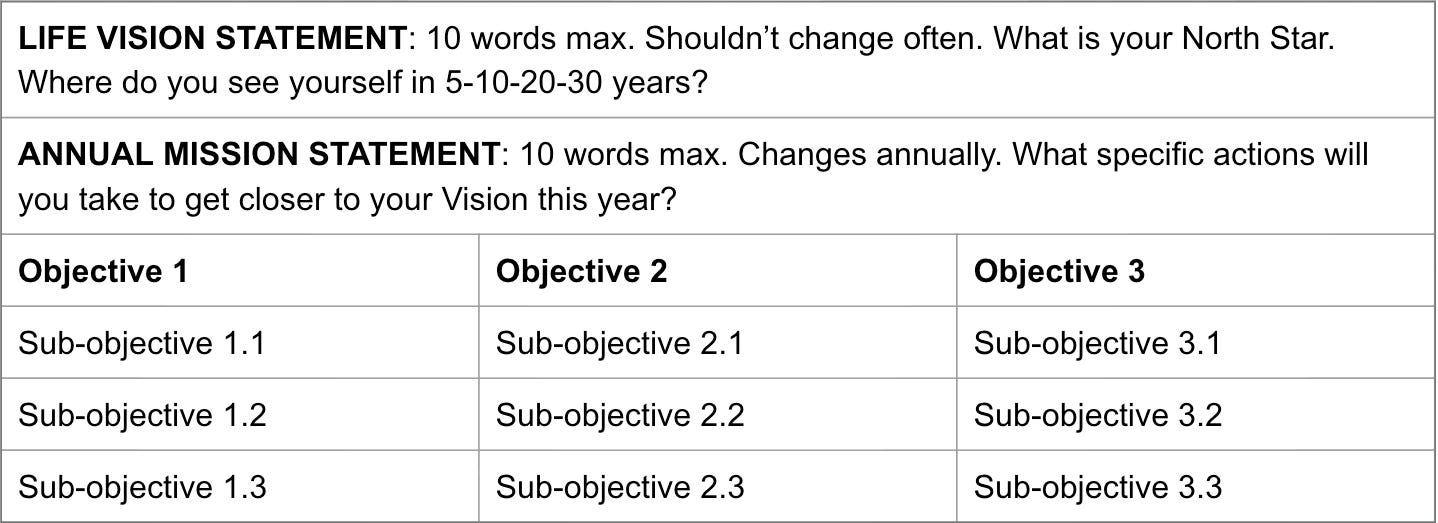
Yes, it’s this simple. And yes, it’s flexible (except for the Vision, try not to change that too much). I try to keep the Objectives mostly in place, even if I change the wording. Note: if you’re into vibe-coding, you can create this matrix in an app and view it in your browser to track this. If not, this can be simply written on paper.
The key is to check in on yourself daily or weekly at most. Every weekday I try to scan my dashboard to remind myself of what’s most important. This way I can better enter my year/month/week/day clear on what I should commit to (and not commit to). It’s all about managing my attention, time and energy.
I also highly encourage time tracking. For example, each week I take 5 minutes to look at the activities I worked on the prior week, and calculate the rough number of hours I spent on them. Those hours then ladder up to the 3 Objectives (again, my app does this). It’s very rare for any of my activities to be outside of my Top 3 Objectives. So everything I spend time on is integrated.
Here’s an example. One of my sub-objectives is to publish a book this year. Writing a book takes lot of time and effort—and I still have a full time job. So I can only realistically allocate 15-30 minutes per day toward this goal. But that time adds up if I’m consistent! So far, each week this year, I’ve been able to spend 50 hours toward the book, or 5 hours per week (after 11 weeks). That’s not bad. A small amount of energy over a long period of time is the surest way to success with larger goals.
Similarly, the essays I write here at Dane’s Narratives are a sub-objective. These essays are being written intentionally. I thought about who I want to be, and decided that authenticity was important. I wanted to think more deeply about topics and post less often. My social media use has gone down substantially this year as a result. My objective is to post one essay every week this year. And I haven’t missed a week yet. Why? Because it’s a sub-objective that I review every day!
And listen—there are always sacrifices involved. For example, writing these essays meant I decided to give up on a different newsletter. The other newsletter was becoming more ‘commercial’ and I wasn’t enjoying it. It was also too closely related to my day job for it to feel like I was writing authentically. So I paused it after 2.5 years of effort. Now I write for the world, not just for my industry.
This is why a Life Vision and Life Mission are so important. Who do you want to be? What do you want? It’s not easy to answer these questions. Most people are blindly going through their day without thinking about them; I know I was.
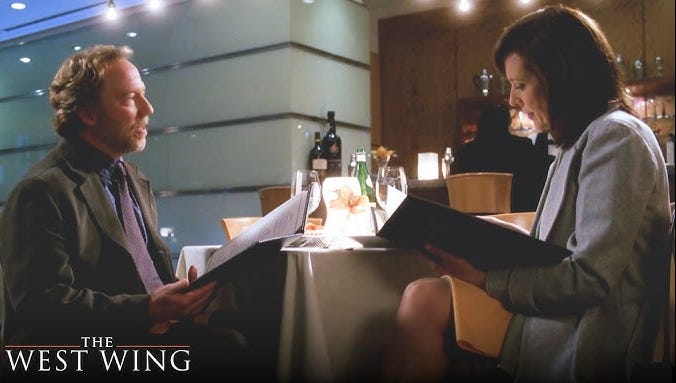
There is a classic scene from an old TV series called the West Wing (one of my favorites). In a final episode, a successful women (CJ Cregg) was wondering what to do as her White House job was ending. She had no idea so her spouse asked her, “What do you want to do?” But she never actually thought about it. She was performing, achieving, and powering her way through life without thinking, “Is this what I want?” By the way, it’s also like that meme from the Notebook movie when Ryan Gosling shouts, “What do you want?!”
Every year my planning process gets simpler. It requires carving out time to imagine the life I want to live, not the life that somebody else imagined for me. This process is painful, especially when I was so used to living a certain way and mostly for other’s approval. But staying authentic and true to who you are is the ultimate goal.
And since my faith is integral to this process, I’ve started to use Pastor John Mark Comer’s techniques in his book Practicing the Way. He inspired me to think more deeply about the way I structure my life, and it’s been a valuable tool in creating my life vision and mission.
In the end, no two lives will be designed the same. But everyone should seek integration. The word integrity comes from the Latin root ‘integer’ meaning whole or complete. To be a person of integrity simply means to live in an integrated way.
This way of thinking helped me discover parts of myself that I’ve left on the sidelines. For example, I never used the word ‘love’ before in my Objectives, yet today it’s front and center. And your plan should include fun items as well. I have a Sub-Objective to visit several National Parks with my wife this year. And this time, I plan to leave in more margin and practice the art of La Calma more.
The main goal is designing life with intentional integration—a deeply authentic sense of awareness instead of busyness and blindness. I’m choosing to live a life of less and I’m finding more life as a result.
AI Disclaimer: ChatGPT was used to help me define Moore’s Law and to define the Latin root of ‘integer’. Everything else is 100% human.