One of my favorite Biblical stories is the book of Jonah. And one of my favorite modern books that I am now reading through is The Hero with a Thousand Faces by Joseph Campbell. And I’m fascinated to discover that the two books are closely connected through the belly of the whale.
I’m learning that this metaphor is often used in modern movies as well. One clear example was in the garbage compactor scene in Star Wars: Episode IV – A New Hope. Or in the Lion King, when Simba collapses in the desert after exile. Or one of my top choices is in The Lord of the Rings when Gandalf falls into the abyss with the Balrog or Frodo when he’s trapped in Shelob’s lair.
Before I continue talking about the belly of the whale, let me take a related detour really quick. I happen to love blue whales and have whale objects all over my house. I feel drawn to them for some reason. Blue whales are part of my personal call to adventure. Writing this essay is part of that call; I hope to not only inspire your own call to adventure, but selfishly it’s also helpful to contemplate my own.
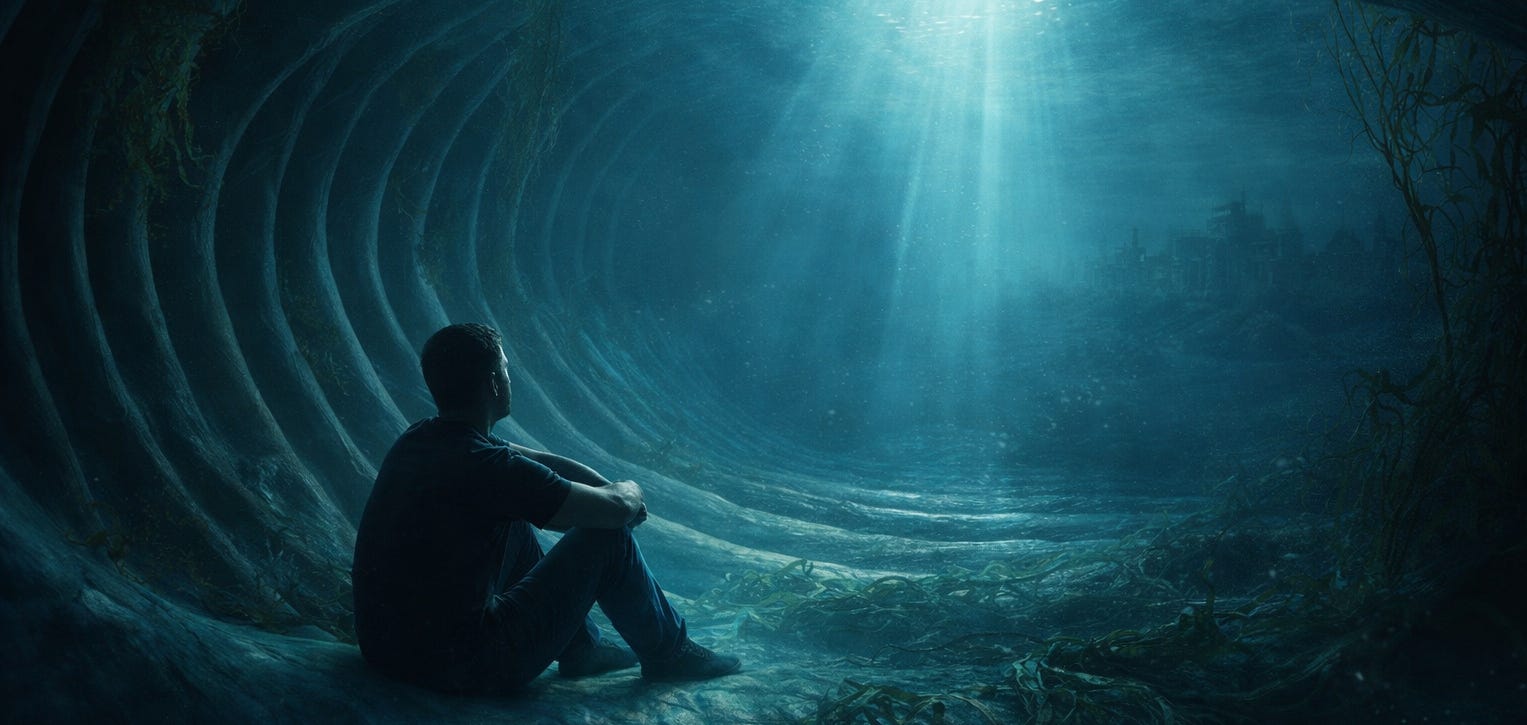
With that out of the way, let’s begin by exploring the story of Jonah, shall we?
This book is about a man named Jonah from Gath-hepher, a small town near Nazareth in the northern kingdom in ancient Israel (8th century BC). This means Jonah lived on the doorstep of a city not too far away called Nineveh, the capital of the rising Assyrian Empire.
If ever there was a threat to Jonah’s village and greater Israel, it would have been from Nineveh. During that time, an invasion could have happened at any point and I’m sure the locals often sent scouts out to report on regional movements. Jonah must have been praying to God for protection from this potential enemy daily.
Instead of destroying Nineveh, God calls Jonah on the adventure to do the opposite, to save them. We often think that a call to adventure is a good thing. But in most tales, the call rocks the protagonist’s world and shakes things up. This is why the call is often followed by a refusal. It’s like when Bilbo tells Gandalf something like, ‘I’m sorry Gandalf, I can’t join you on your quest.’
So it comes as no surprise that when God asks Jonah to go to the city of Nineveh to save them, Jonah refuses the call. How can he save his enemy? He would be a traitor to his nation and people! He probably thinks that Nineveh is a city of total chaos and disorder, deserving of God’s wrath. He will also likely be killed if he goes there as a foreigner shouting warnings in the streets, disrupting commerce, and calling upon masses of people to change their sinful lives.
It’s also a prophetic parallel to what occurs eight centuries later, as Jesus enters the world to save humanity. But unlike Jesus, who obeys God’s call, Jonah refuses the call in dramatic fashion. This brings up the most well known part of the story.
He runs away to a port city called Joppa (or modern day Jaffa, now part of Tel Aviv). He catches the next boat ride out of town. The problem was that God happened to control the weather, and caused a storm and waves to nearly tip over the boat. Jonah had nowhere to escape to. The captain of the boat and his crew realized Jonah was to blame for the calamity, and at Jonah’s suggestion, they tossed him overboard.
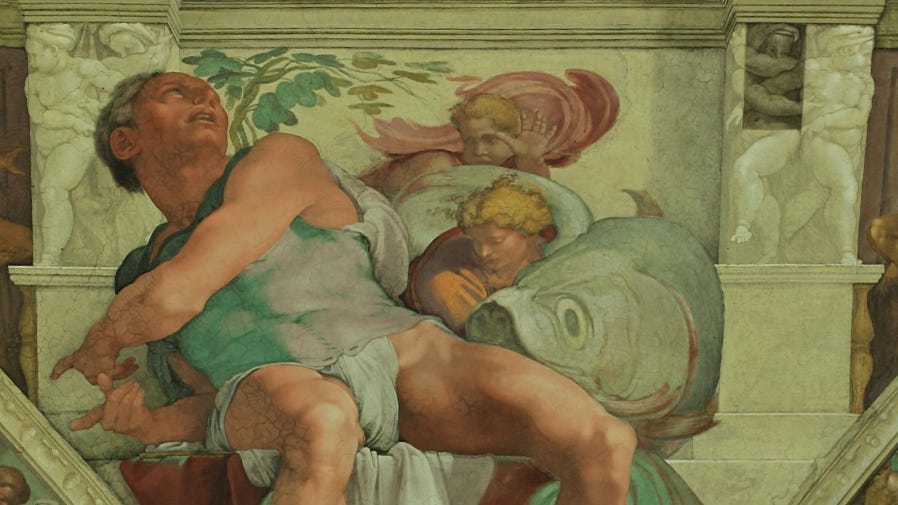
To Jonah, dying was clearly preferable to saving the people of Nineveh. That’s how much he detested them. Yet God sent a whale to swallow Jonah, where he then sat(?) and wrestled with God for three days. Talk about a private place! I sometimes wonder how he sat down or if the whale also swallowed a nice piece of furniture that was tossed overboard from the boat, but I digress.
In the belly of the whale, Jonah faces the darkness. But he stops running away and instead he spends most of his time praying. His prayer reveals a significant point of surrender within this ‘womb’ before being reborn.
“From inside the fish Jonah prayed to the Lord his God. He said: “In my distress I called to the Lord, and he answered me. From deep in the realm of the dead I called for help, and you listened to my cry. You hurled me into the depths, into the very heart of the seas, and the currents swirled about me; all your waves and breakers swept over me. I said, ‘I have been banished from your sight; yet I will look again toward your holy temple.’ The engulfing waters threatened me, the deep surrounded me; seaweed was wrapped around my head. To the roots of the mountains I sank down; the earth beneath barred me in forever. But you, Lord my God, brought my life up from the pit. “When my life was ebbing away, I remembered you, Lord, and my prayer rose to you, to your holy temple. “Those who cling to worthless idols turn away from God’s love for them. But I, with shouts of grateful praise, will sacrifice to you. What I have vowed I will make good. I will say, ‘Salvation comes from the Lord.’ ”
And the Lord commanded the fish, and it vomited Jonah onto dry land.”
Jonah 2:1-10 NIV
https://bible.com/bible/111/jon.2.1-10.NIV
After this prayer, he is then spit out by the whale onto a beach, and (after taking a bath I suppose) goes to Nineveh, where he preaches God’s warning of imminent destruction. They surprising part is that they actually listen to him and repent so God shows them mercy.
But Jonah thought God was wrong. He shouts at God, complaining about why he saved them. God replies, ‘Is it right for you to be angry?’
Then after Jonah says he was so angry that he’d rather be dead, God says, “And should I not have concern for the great city of Nineveh, in which there are more than a hundred and twenty thousand people who cannot tell their right hand from their left—and also many animals?”
Jonah 4:11 NIV
https://bible.com/bible/111/jon.4.11.NIV
In this reply, the heart of God is revealed. He cares about people, and people are in cities, so he watches our world’s cities with interest.
But let’s dissect the belly of the whale moment for Jonah. What does this the narrative principle and archetype mean? What is the modern day equivalent of our ‘belly in the whale’ moment?
Joseph Campbell writes on how this is a necessary step in every Hero’s Journey. I’ve asked for some help from ChatGPT to synthesize this journey stage for us:
In the “Belly of the Whale” stage, the hero has crossed into the unknown and is fully consumed by it. This marks total commitment and the point of no return, where the old identity ends. Being swallowed symbolizes initiation, not destruction—a symbolic death necessary for transformation. Across myths, the dark, enclosed space represents a womb rather than a grave: what appears to be annihilation is actually preparation for rebirth. Cut off from society, the hero enters isolation without validation or support. In that solitude, confrontation with the unconscious begins, and the groundwork for a new self is formed.
This is very revealing. The story of Jonah is much deeper than I ever imagined. Jonah in the belly of the whale represents a womb that symbolizes rebirth and transformation.
I think most of us have had these Jonah moments in life. We 'reach the end of our rope’ and get to a point where there is ‘no more hope’. Maybe we lose a loved one. Or we lose a career (think of all the AI-related job replacement happening today). Many of life’s turning points are part of our own Hero’s Journey, and we must enter the belly of the whale to confront the unconscious and emerge stronger.
Since there is such a deep psychoanalytic perspective here relating to the depths of our inner consciousness, I also asked ChatGPT to summarize this perspective for us:
From a psychoanalytic, especially Jungian, perspective, the “Belly of the Whale” represents a descent into the unconscious. The hero confronts shadow elements—fears, repressed desires, unresolved conflicts—and undergoes ego dissolution as the rational identity loses control. The womb imagery signals a symbolic return to origins: a breakdown of the old ego and a temporary regression before rebirth. This is a psychic reset. In Jungian terms, individuation begins here through isolation, surrender, and confrontation with the Self. What feels like collapse—loss, upheaval, inner chaos—is actually the hidden construction of a more integrated and transformed identity.
So this metaphor has multiple deep meanings. There is the Hero’s Journey mythical archetype dimension, the psychoanalytic dimension, and the spiritual dimension. Isn’t this fascinating?
This story captivates me on many levels. As a storyteller and writer, the narrative and mythical dimension has me rethinking my stories. As someone drawn to whales, the metaphor intrigues me. As a student of history, the historical dynamics are fun to learn about.
And as a Christian, the spiritual dimension adds to my fascination, because Jesus brought up Jonah in the book of Matthew when he points to Jonah as the ‘evidence’ that the Pharisees are looking for.
In Matthew 12:40, Jesus explains:
“For as Jonah was three days and three nights in the belly of a huge fish, so the Son of Man will be three days and three nights in the heart of the earth. The men of Nineveh will stand up at the judgment with this generation and condemn it; for they repented at the preaching of Jonah, and now something greater than Jonah is here.”
Matthew 12:40-41 NIV
https://bible.com/bible/111/mat.12.40-41.NIV
I wonder what he means by ‘heart of the earth’ here. It must be about his death, burial and entrance into the realm of the dead. It’s like in Jonah’s prayer when he says, ‘You hurled me into the depths, into the very heart of the seas, and the currents swirled about me’. Jonah’s prayer was foretelling the death and resurrection of Jesus eight centuries later.
If we draw upon the belly of the whale archetype to think about our own lives, it becomes instructive. For example, maybe you’re going through a ‘midlife crisis’, or an ‘identity crisis’. This might be your belly of the whale moment. This is where your rebirth can occur if you trust the process, find solitude, and move forward on your heroic journey.
But trust and solitude aren’t easy to find. If you’re wondering what is your Nineveh, Balrog, Scar, or Shelob, perhaps it’s more obvious than you might think. I would argue that constant social media, entertainment, and other mind-dumbing activities, are today’s modern enemies, helping us more easily avoid the solitude required to contemplate our call.
But that’s the fight. It’s not to learn more, to do more, to post more, or to experience more. We have more stimulation and knowledge than any generation in history, and it’s not working out for many.
So like Jonah, we may often run away when we’re called to adventure. But no matter how far we run, we can’t escape the belly of the whale. It’s in this dark womb where we must die to our false selves and can then answer the call with faith and courage.