
The Tower of Babel
The AI revolution reminds me of an ancient Biblical story — the Tower of Babel.
If you’re unaware of this story, I asked ChatGPT for a summary (see what I did there):
According to the Book of Genesis, humanity once spoke one language. United and ambitious, they decided to build a city with a massive tower reaching the heavens—to make a name for themselves and prevent being scattered.
God saw this as dangerous pride and centralized power. To stop it, He confused their language, so they could no longer understand one another. The project collapsed. People scattered across the earth, forming different nations and languages.
Babel comes from a word meaning confusion.
As the saying goes, “history doesn’t repeat itself but it does rhyme.”
After all, AI is a concerted effort by humanity to remove language barriers to create an integrated intelligence system (a proverbial tower).
Throughout this essay, I’ll refer to this moment as a ‘Tower of Bubbles’ — a system built on shared narrative and capital ahead of proven returns.
1929
Andrew Ross Sorkin is a financial journalist and co-anchor of CNBC’s Squawk Box and a bestselling author. And he just published a book. It’s called 1929: Inside the Greatest Crash in Wall Street History.
It’s about the lead-up to the 1929 crash and its aftermath in the era that helped trigger the Great Depression.
The reason this book is flying off shelves is because the 2020’s look eerily similar to where we were a century ago in the 1920’s, when capitalism hit a peak. It feels like we’re living through the Roaring 20’s all over again.
If you’re unfamiliar with that period of time, here’s a ChatGPT provided summary for you:
The Roaring 20s marked a high-water moment for peak capitalism: mass production met mass consumption, credit expanded, and optimism turned into leverage. Stock speculation, consumer debt, and financial engineering surged faster than real productivity, creating the illusion of endless growth. Wealth concentrated, warning signals were ignored, and markets began pricing perfection—until the system’s fragility was exposed at the decade’s end.
Sound familiar? It’s nearly a carbon copy of where we are today when it comes to the AI boom.
Are We in a Bubble Today?
Sorkin says, “It’s hard to say we’re not in a bubble of some sort, the question is always, when is the bubble going to pop?”.
Take a look at his interview with 60 Minutes recently (start at 2:32). He says the economy is being artificially (pun intended) “propped up” by the AI boom and that “it’s either a Gold Rush or a Sugar Rush and we won’t know for a couple of years which one it is.”
His in depth study of the Roaring 20’s found the following required elements prior to the Great Depression: increasing market speculation + increasing debt + investment democratization - consumer guardrails = the situation just before 1929.
We have those same elements in place today. Larry Fink, Chairman of the world’s largest investment manager, Blackrock, wrote a letter to investors titled “the democratization of investing”. In it, he begins with this admission: everyone he talks to is “more anxious about the economy than any time in recent memory.”
Enter Michael Burry and the ROIC Pin
Enter Michael Burry.
He has shorted Nvidia and Palantir, clearly indicating where he stands on the matter. In his Cassandra Unchained Substack he writes about how the bubble popping will depend on whether AI delivers what he calls the “measure of all measures” — ROIC (Return on Invested Capital).
In other words, the trillions of dollars being spent on capital expenditures (chips, GPUs, data centers) has to show ROI at some point.
Are Sorkin and Burry both wrong? I mean, how much are we spending on AI anyway? How bad could this be? Well, Goldman Sachs estimates global AI-related infrastructure spending could reach $3 trillion to $4 trillion by 2030.
And it’s continuing in 2026. Meta’s projected total 2026 AI infrastructure spending (CapEx) amount is between $115 billion and $135 billion.
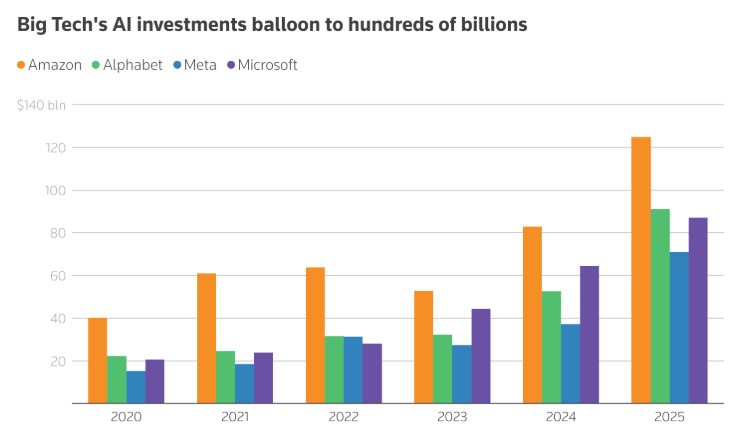
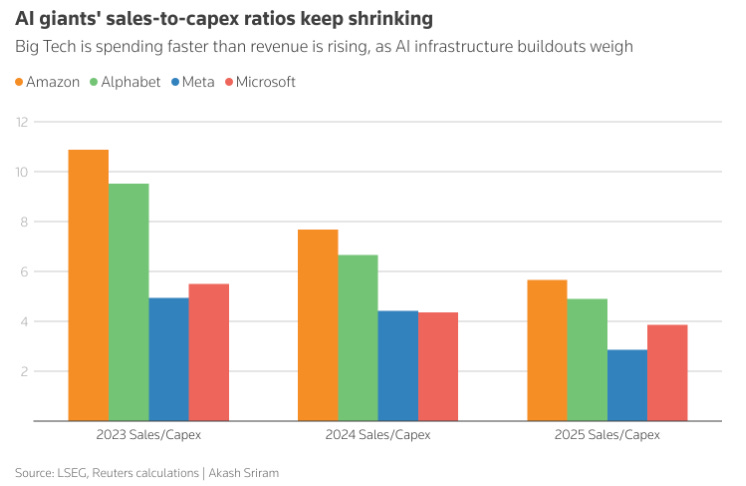
Okay, so what? I mean, CapEx investment is a good thing. Especially since it should lead to more ROI right? This is where the story starts to take a dark turn. It turns out that sales-to-capex keeps shrinking.
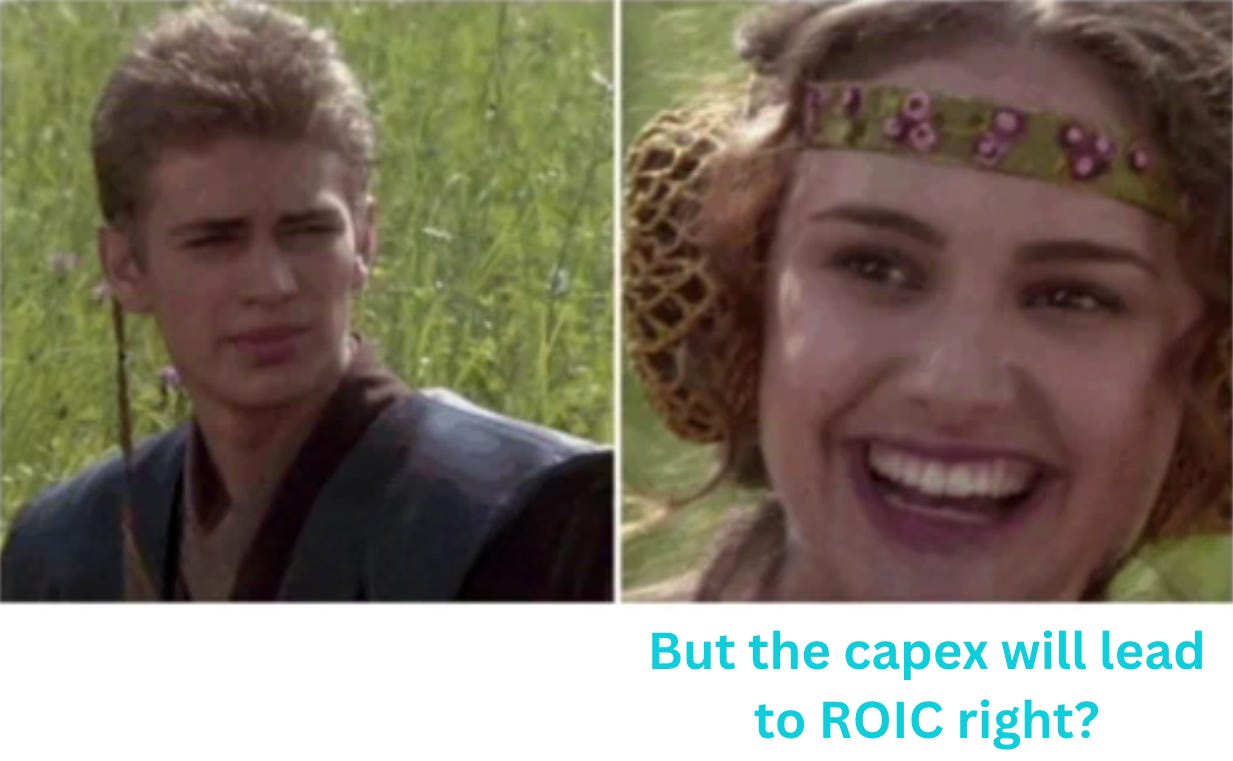
I thought it necessary to amplify this point with a Star Wars meme.
Is AI CapEx Propping Up Markets?
Two key areas are receiving the AI CapEx investments, which are propping up overall economic growth.
First, is startups. This funding surged to roughly $192.7 billion in 2025, marking a new global high and representing more than half of all VC dollars deployed (PitchBook and Bloomberg).
Next is AI-related data centers. Sorkin points out a recent report from Jason Furman, an economist at Harvard, which says if spending on AI-related data centers went away, US growth would have been flat in 1H 2025 (0.1% as of Oct. 2025).
Rising tides lift all boats but some boats are rising higher than others. AI-linked stocks as a group have outperformed the S&P 500 by a wide margin (over 136 % relative gain) over the past five years.
It’s been a great run for “Mag 7” shares (AAPL, MSFT, NVDA, AMZN, GOOGL, META, TSLA), and for indexes as a whole (e.g. in VTI, QQQ, SPY). In 2025 the S&P 500 set ~38 record highs across the full year (2024 saw 57).
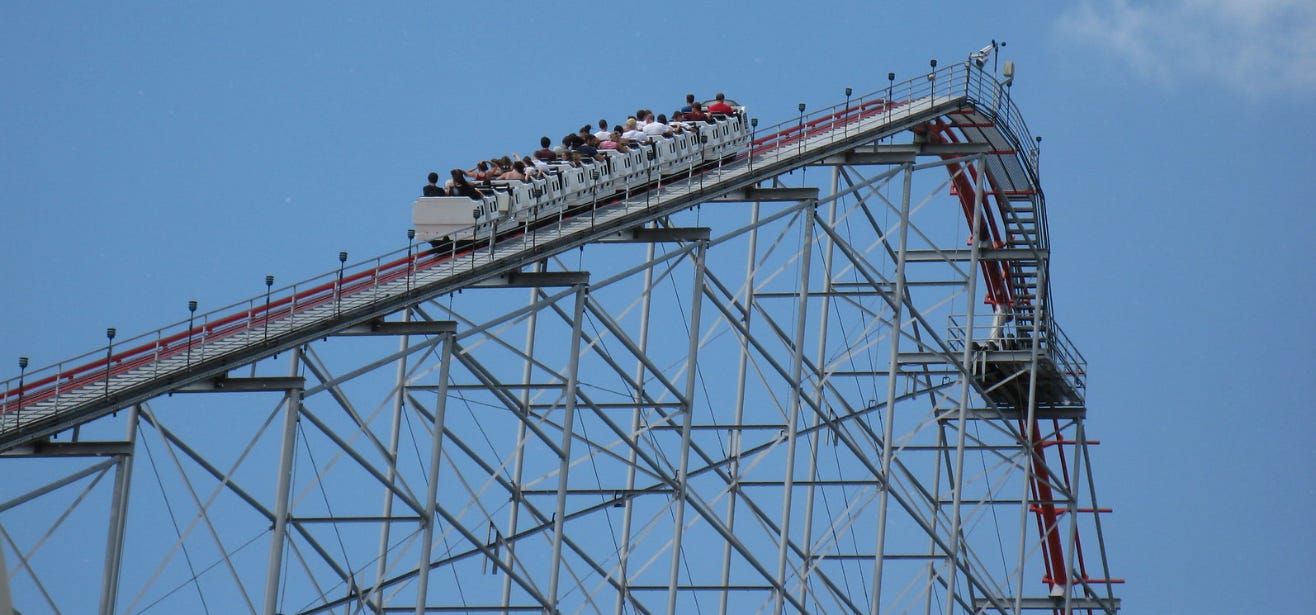
The Lift Hill
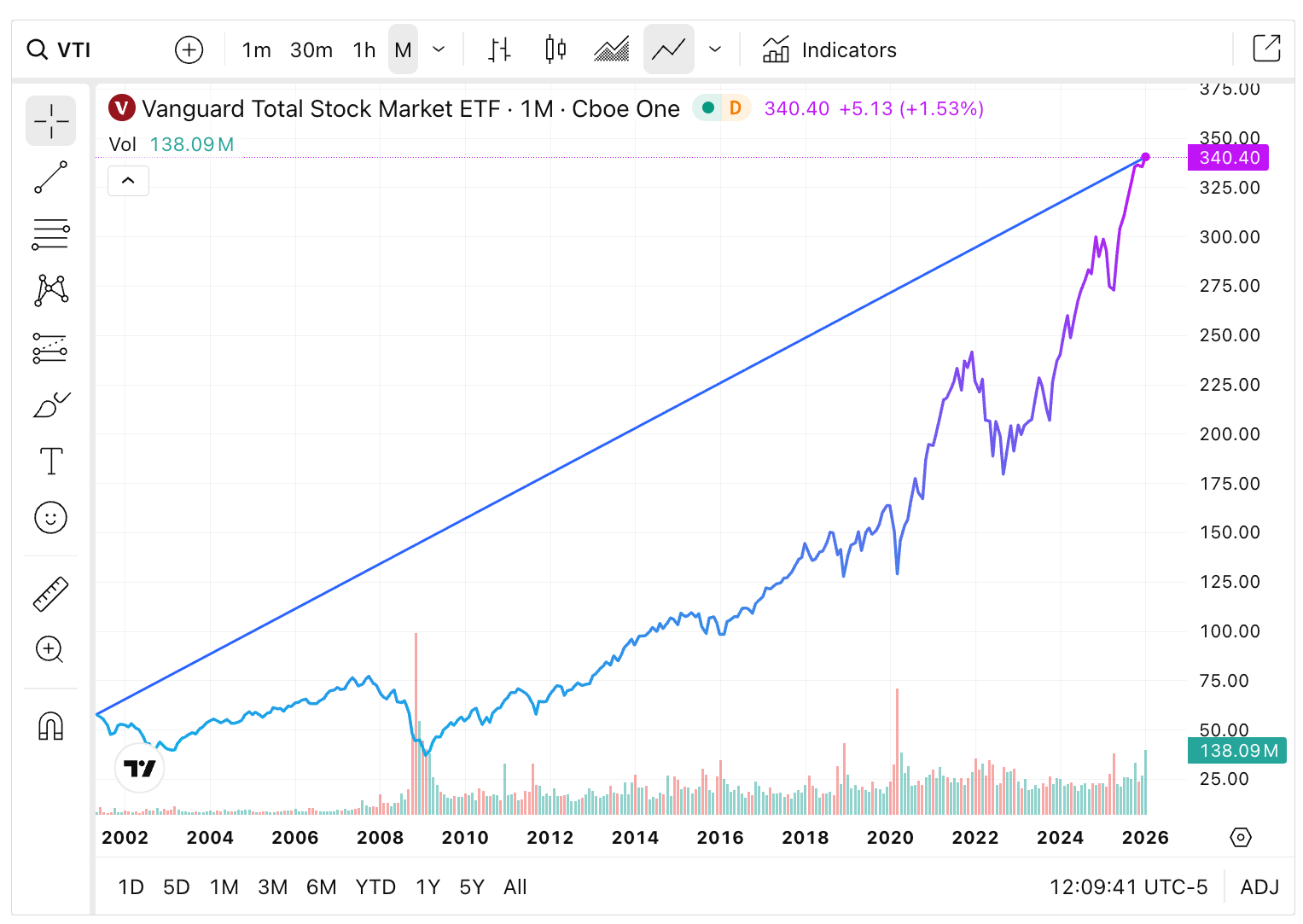
VTI is an aggregate view of nearly every publicly traded U.S. company. An investor would have doubled their money since 2020 simply by parking it in VTI.
The linear trend line from 2002 to today has been a “lift hill”. A lift hill is that slow click-click-click climb that pulls the coaster up to its highest point. Before the big drop.
Why does spending continue?
This is a result of an “AI Innovator’s Dilemma”. Existing industries must spend on AI, or risk being disrupted by it. That’s the dilemma, “Do we spend on CapEx when the market is showing revenue, or do we spend now before it’s too late?”
This is the dilemma with AI CapEx. Meta announces $135 billion in CapEx, so Google does the same, so Microsoft does the same, so Amazon does the same, and on and on. Meanwhile, Nvidia and TSMC and their suppliers pile up cash.
Michael Burry tells a story from Warren Buffet in his recent conversation with Jack Clark and Dwarkesh Patel in The Substack Post. The story is about two department stores on opposite sides of a street. One store installs an escalator, so the competitor across the street says, “I better do the same.” They both made a huge CapEx investment only to establish equal footing. So nobody wins.
The Tower of Bubbles

In the case of AI, the “escalators” are represented by the shared narrative that investing in AI infrastructure will create Artificial General Intelligence (AGI), leading to a prosperous society for all to share in. Once built, we’ll have the “option to work” because AGI will be doing everything for us with the only limits being compute and energy.
This narrative is embodied in what I’m calling a Tower of Bubbles, made up of every entity involved in the current post-pandemic AI boom cycle.
The “bubbles” that make up the tower are any asset or enterprise whose valuation is sustained more by narrative and expectation than by current or plausibly achievable return on invested capital (ROIC).
Let’s define AGI:
How I Define AGI (without help from AI): the widespread adoption of AI systems that are able to think and act like humans at every layer of society.
How ChatGPT Defines AGI: AGI (Artificial General Intelligence) is an AI system that can learn, reason, and apply knowledge across any domain at a level comparable to a capable human—without being retrained for each new task.
A group of ~100 global AI leaders are spreading this AGI narrative on podcasts, at Davos, and at an endless number of summits. They are the world’s heroes. I’m glued to everything Jensen Huang says; he’s truly inspirational. But I have to remind myself that it’s entirely in his interest for AI infrastructure spending to continue, which is perhaps why he’s making so many public appearances.
The Collapse

If Sorkin is correct, we’re living in a bubble and if Burry is correct, ROIC will be the “pin” that pops it.
When it happens, the bigger bubbles (Mag 7, AI-linked orgs, Major Investors) will likely survive through bailouts (AI now seen as national security) or massive corrections to valuations. A percentage may be allowed to dissolve to set an example like Bear Stearns in 2008.
The tiny bubbles (the thousands of AI startups) that are currently receiving a record amount of funding will lose funding and mostly go bankrupt with talent and IP being absorbed by the remaining survivors.
Banks, asset managers, 401K’s, and pension funds will be hit hard in the correction. This is where the biggest societal risk will lie: populism and mass unemployment. This could trigger the government to print more money for stimulus checks on top of bailouts, setting the stage for inflationary effects.
How to Prepare
I didn’t buy a bunker and I’m not “prepping” as I write this. I’m living life and still invest in markets. But even the world’s most respected investor, Warren Buffet, is strategically stockpiling cash. I think that might be the best indicator of all in this story.
And I’m doing the same. Even if it’s saving $25 a week, just prepare some ammo. That doesn’t mean, “We’re doomed. Give up.” It simply means, “Be ready.” The correction will be a buying opportunity.
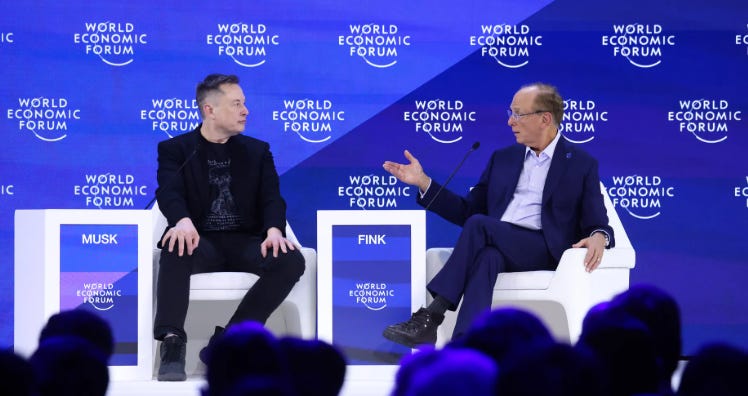
Elon Musk’s mindset shift is helpful here: it’s better to be an optimist and wrong, than a pessimist and right. He says there will be more AI-fueled robots and cars than people, which requires institutional investment through big players like Blackrock. Perhaps this is why Larry Fink was on stage with Elon at Davos last week?
AI infrastructure will still move forward as the new digital intelligence infrastructure. The work on AI must continue in the interests of economic and national resilience. The surviving AI-linked companies will become a great investment opportunity, especially assuming they will be trading at amazing discounts, like Amazon was after the dot com bust.
And I’m personally excited for the potential of an AI future. From interactions with Optimus robots, to flying cars, to AI headsets—sign me up as a future early adopter of all of these technologies.
But for any of this to work, the prosperity of AI will need to be shared. Nobody could have stopped the spread of electricity after it was invented. The genie’s out of the bottle with AI. Yet how each one of us chooses to use “the electricity” is up to us. We are individually responsible for transforming the utility into societal value.
Closing
So be ready for the opportunity in the tower collapse. Also be ready for the collapse NOT to happen on your watch. Worst case, you will save some cash for a crash that doesn’t happen.
A final reminder. This is all natural. Our economic system is literally built on the idea that we have to destroy the old to create the new. Yes, there will be casualties as the economy and society restructures.
In 1942, Joseph Schumpeter called this dynamic “creative destruction”.
Joseph Schumpeter introduced “creative destruction” most clearly in his 1942 book:
Capitalism, Socialism and Democracy
That’s where he defines capitalism as an evolutionary process that constantly destroys the old while creating the new—industries, firms, jobs, even social structures.
I close with Sorkin’s 60 Minutes interview, where he’s asked about the timing of all this, because that’s the hardest part to predict. He states, “It’s hard to know how things get out of control. When confidence disappears, it happens like this.” As he says “this”, he snaps his fingers.
The interviewer then asks, “Do you think that we will have a crash?” He confidently replies, “We will have a crash, I just can’t tell you when.”
Like the Tower of Babel, LLMs will disperse into their own sovereign AI direction when the Tower of Bubbles collapses, and the great reset will begin.