

Introduction
I’m in the eye of the AI storm. I’m a mid-career, white collar tech industry employee and an early adopter of AI. I went all-in from the time ChatGPT was launched just over 3 years ago.
When I started using it, it was like the first hit of a drug. Once I got my first dose, I went back to ChatGPT like, “Got any more of that Chat?” And the more I used it, the more addicted I became.
Using AI has proved that the more I can do, the more I feel obligated to do.
Fast forward to today, I’m beyond an overdose. It’s been a 3-year long AI binge. I use it so much that my wife started calling me “The Robot”.
The other day I used 5 LLMs in a single day. I used ChatGPT, Grok, Meta, Claude, Gemini and my employer’s internal LLMs. I also use apps for every creative task imaginable, like Canva, Runway, and Descript. And I now build my own apps and agents with Cursor.
These past few years I’ve increased my productivity in ways that I never dreamed possible. That’s all great, but something feels off, and it’s not just me.
The AI Gnaw Condition
Like for many AI power users, the constant pressure to task AI has left me unfulfilled and in a state of low grade burnout. Tony Robbins would say that I’m facing the dilemma of achievement vs. fulfillment. There’s a big difference, he’d say.
Here’s how I sum it up: AI has made me think that I could, and therefore should, be doing more all the time.
I call this condition the AI Gnaw, defined in my personal experience as (and with a little help from ChatGPT):
The AI Gnaw Effect: a persistent psychological pressure felt by AI power users—the anxiety that if you could generate more tasks for AI, you should.
Jack Clark, the co-founder of Anthropic, has recently expressed a similar sentiment:
“This palpable sense of potential work - of having a literal army of hyper-intelligent loyal colleagues at my command - gnaws at me. It’s common now for me to feel like I’m being lazy when I’m with my family. Not because I feel as though I should be working, but rather that I feel guilty that I haven’t tasked some AI system to do work for me while I play with Magna-Tiles with my toddler.”
Source: Import AI https://substack.com/home/post/p-185033372?selection=a4a560b9-bf89-4547-9218-9e01a00d0d3c
Here we have one of the main figures in AI, talking about the same gnawing feeling. He feels guilt when he hasn’t “tasked some AI system to do work”. Bingo. That’s it.
So if I feel The Gnaw, and Jack feels The Gnaw, then maybe you do too? Perhaps it’s a societal condition many are suffering from? Let’s explore that.
The Gnaw is a generative condition responsible for massive energy and GPU usage increase. Every GPU we task triggers more energy used by Generative AI.
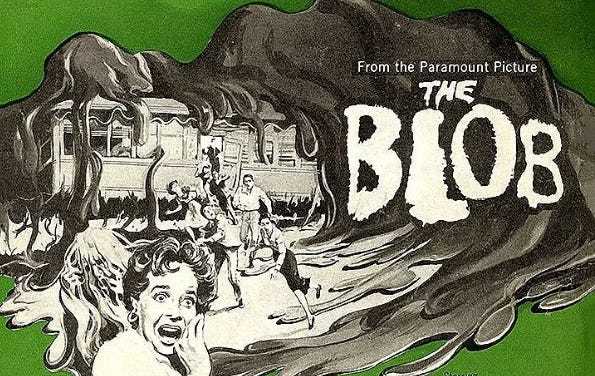
It reminds me of an old 1950’s movie called The Blob (later redone in the 80’s). Set in a small American town, a mysterious meteor crashes nearby. Inside it: a gelatinous, living organism—the Blob. At first it’s small and slow. But every person it absorbs makes it bigger, faster, and smarter.
Replace the Task, not the Purpose
The Gnaw is similar to The Blob, getting faster and smarter as it consumes every AI power user in its path. We early adopters quickly surrendered to it, realizing that it’s faster and smarter than we are. Instead of resisting, we outsourced our energy and cognitive load to it.
And why not? To us, it’s like the progression from walking to biking to driving. By surrendering to The Gnaw, we learned to stop trying to be a “genius”. Instead, we are becoming a “genius at tasking AI”.
But tasking AI has come with a cost. When we replaced our Tasks with AI, an addiction started. Like The Blob expanding, The Gnaw created a constant urge to replace every Task with AI. This began exposing Purpose. Because when Tasks collapse, Purpose is exposed.
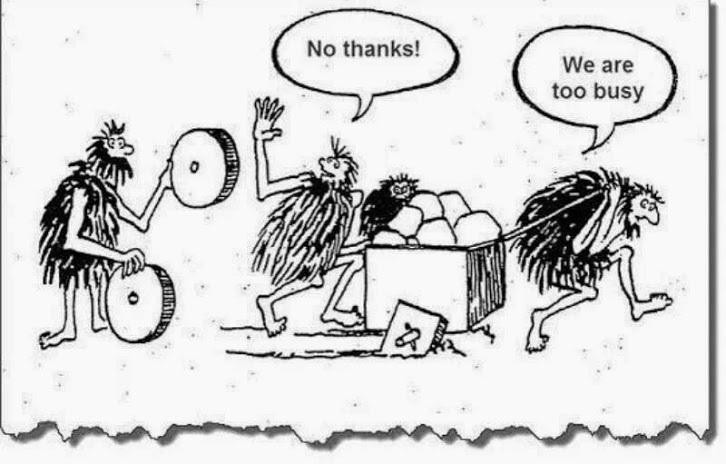
To illustrate Tasks vs. Purpose, I like to use the meme where the wheel was invented. Everyone is running around pulling boxes of rocks, trying to justify their Tasks not realizing that a wheel would serve the same Purpose, just faster and more efficiently.
Jensen Huang is often asked about how AI will destroy jobs. He usually responds with, “AI will replace the Task not the Purpose”.
He illustrates with this example: “If you observed me working, you would think that I’m a Typist. That’s the Task I do. AI can replace that Task. But it can’t replace my Purpose, to lead Nvidia.”
So if your Purpose is the Task, The Gnaw will consume you.
Quick Personal Example
Take my current day job for example. My inputs are 1) requests to explain the products my company sells, and 2) requests from execs to explain our products to an audience.
I perform a variety of Tasks to deliver outputs like messaging docs, presentations, event plans, videos, and web pages. This is the “box of rocks” that I’ve been pulling around for over 15 years. I take Time to work on Tasks like writing documents, building presentations, presenting to audiences, and joining calls.
The outputs of these Tasks include more clicks on compelling web pages, better keynotes that drive action at events, and more customers in our Sales pipeline. All of this leads to more revenue, more profit, and more shareholder value. I am an instrument of the capitalist market system.
The Tasks to deliver those outputs can now be “carried by the wheels” of AI. I would be a fool not to use those wheels. AI doesn’t autonomously do them yet, so I can still add value to my employer by managing AI. My Purpose is no longer doing the Task, it’s tasking AI.
So The Gnaw is absorbing my Tasks day by day. And good riddance. Less work for me. But I can see why many white collar workers are experiencing existential dread. Layoffs are creating panic about someone’s role being found out as “the Task”.
It’s starting to look like the movie “Office Space” when Corporate is looking into what people in the office actually do. In an iconic scene, two consultants (“the Bobs”) are brought in to evaluate staff. They sit employees down one by one and ask the classic line:
“So… what would you say you do here?”
This. This is what’s happening across all of Corporate America. AI Consultants are the new Bobs, as The Gnaw is growing.

AI native startups are proving that more employees aren’t the answer to revenue growth. They are growing faster and with more revenue per employee than ever recorded. It’s the new North Star — using AI to increase revenue per employee.
2025 ushered in the “year of Agentic AI” as Jensen Huang announced in January last year. He was right. I think 2026 is the year where we’ll see more resistance and cynicism with AI. These are natural growing pains.
Should we stop The Gnaw before it’s too late? I don’t think we can, or should. This is the nature of economics.
In 1942, Joseph Schumpeter called this dynamic “creative destruction”. I prompted AI for a better definition and here is what it generated in 2 seconds:
Joseph Schumpeter introduced “creative destruction” most clearly in his 1942 book:
Capitalism, Socialism and Democracy
That’s where he defines capitalism as an evolutionary process that constantly destroys the old while creating the new—industries, firms, jobs, even social structures.
The AI Gnaw is just an evolutionary economic process. In this definition, you’re either “creating the new”, or you’re the “old being destroyed”. Take your pick.
Surviving The Gnaw
In this Gnaw world, there are one of two sides you will find yourself on—you’re either the “old being destroyed” as the Task. Or you are “creating the new” and managing AI to replace the Task.
If you’re “the Task”, you’re like the Typist in Jensen Huang’s earlier example. It’s time to begin using AI to type. Just accept that AI is better, figure out how to do your job with AI, and then do it.
And avoid trying to use “strategic incompetence” defined as:
Strategic incompetence is the deliberate choice to appear bad at something in order to avoid responsibility, effort, or accountability—while still benefiting from the outcome.
There’s no excuse to not learn AI. It’s the easiest technology to learn and use, ever. All you have to do is talk to it. If you don’t get it, start with “I don’t understand how to use AI, can you help me get started?”
If you’re an AI power user obsessed with its implementation, you’re more at risk from burnout than from being replaced. But you also need to accept that you will never run out of Tasks you can automate with AI. Treat AI as something you manage in order to gain Time, and then use that Time wisely.
This is where we now turn our attention.
AI Managers Need a New Contract
You might think, sure, using AI is easy, but managing AI hasn’t reduced my workload and given me more time. And you’d be right. Of all things I’m doing with AI, saving time is not one of them. But that’s been my choice.
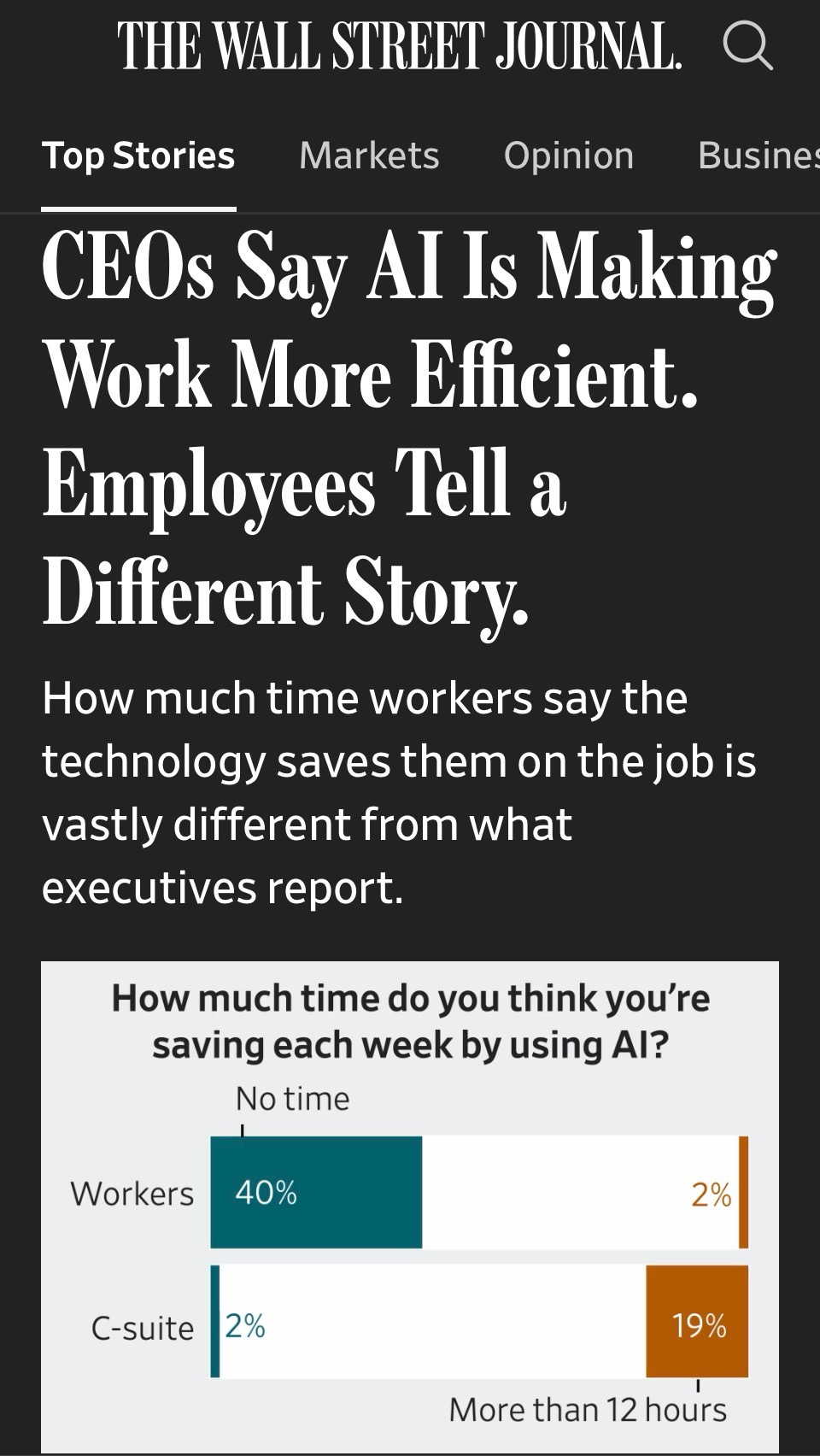
40% of white collar workers agree (see below WSJ article). An outdated contract still uses Time as the only measure of efficiency. But Time is only one input. This article’s graph misses those factors. Let’s analyze this a bit more.
A new contract is needed that measures our efficiency with new factors—Energy and Cognitive Load—instead of only Time. Let’s dive in and give this a shot.
Existing Contract
Here’s what the existing/old employer contract looks like in reality. A white collar worker’s efficiency is a function of how much Time we take to complete Tasks that lead to Valuable Outputs. The Tasks are performed using Energy and Cognitive Load. The more experience we have, the better we are at managing our Energy and Cognitive Load.
If it was written as a formula it might look something like this:.
Worker Efficiency = Valuable Output ÷ (Worker Time x Worker Energy + Worker Cognitive Load)
New Contract
In the new contract equation Workers use Time to manage AI to perform the same Tasks, so AI absorbs the Energy and Cognitive Load elements. See how they disappear in the new formula:
Worker (Manager of AI) Efficiency = Valuable Output ÷ Worker Time (To Manage AI)
In this contract Workers are measured based on the Time it takes me to manage AI. Experience is no longer a limiting factor because AI is trained on experience to deliver Valuable Outputs perfectly.
Human experience still matters though because AI isn’t flawless (hallucinations, poisoning, unoriginal ideas). This is why all companies still insist on “human in the loop”.
This is also why managers of AI are still needed. In my line of work, not having a human in the loop would be like allowing an autonomous agent to generate and publish messaging to a website without review. That’s just not happening any time soon.
And this is why everyone keeps saying, “you won’t lose your job to AI, you’ll lose your job to someone who uses AI.” Exactly right.
Fighting The Gnaw
In conclusion, ending The Gnaw means embracing AI to gain Time. Accept AI’s capacity to replace your Tasks, and begin to manage it to deliver Valuable Outputs. Then use the Time you gain wisely.
That’s the new contract. We can finally stop thinking about work in terms of “40 hours per week” thinking. Think in terms of Valuable Outputs instead of just Time as the only measure of your efficiency. Outsource the Energy and Cognitive Load to GPUs.
Employers—you can reward your star AI managers with the most important human resource—Time. That’s what we want the most.
Maybe this is why Elon Musk thinks we’re heading toward a future where “work will be optional”. I’m not banking on that outcome. But by managing AI wisely, I gain Time that I can choose to spend on soul-enriching Tasks.
I choose to use my Time to unplug from The Gnaw—from anything requiring GPUs to function. For me, that means going outdoors, writing essays like this, and spending time with loved ones. These are my SPUs—Soul Processing Units.
AI, when managed well, provides me with Time to spend on what matters most. That’s how I will fight The Gnaw.